I do not use any aids viz. drawing the pattern with chalk piece, using scale to get perfect symmetry. Whatever symmetry I attain is through practice only. Use the white rangoli for daily purpose.
Traditional kolam art followers emphasise the use of only rice flour to create this art. For beginners it will be difficult to control rice flour among the fingers due to the texture.
It is floury, true to its name and hence will not flow freely. The lines and patterns will appear discontinuous, and the result may not be appealing if you are trying it for the first time.
People with lots of experience can manage with dry rice flour.
To encourage many more to try this art also because there appears to be some degree of reduction in the number of practitioners who draw daily, particularly in cities, it is preferable to use a mixture of rice flour and white kola podi.
This will ensure that the good qualities of both these ingredients that are required for an excellent outcome are utilised.
In Chennai, I have seen some areas particularly Mylapore, Thiruvallikeni, West Mambalam and in suburban areas display lot of daily kolam designs
To reiterate, this design may look innocuous but drawing all the petals of almost the same length and size needs lots of focus and concentration.
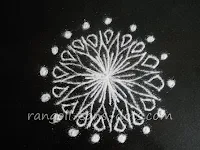 |
| white kolam circular in shape |
Same small and easy rangoli with colours for Diwali.
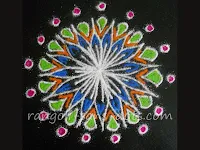 |
| Simple and small beautiful rangoli with colours |
I hope you will agree that the rangoli drawn above is reasonably symmetric. This design can be used as the central part of a bigger rangoli. We can start with this and then expand. As a matter of fact, the flower design is most commonly used.
Here there are 16 petals. We can have 8 or 32 petals too. Optimum number is 16, for drawing 32 we should use the thin line technique. Whatever the number the gaps have to be filled with some simple patterns.
Next a simple freehand without chukki rangoli - all steps shown in a single image to show how the final design is obtained. Occasionally I share such images hoping that it will be user friendly instead of using separate images.  |
| simple flower rangoli design with steps |
I get personal messages (DM) for drawing rangoli designs for functions and weddings. I politely decline the requests though the organisers promised to pay for my art. Somehow, I am not inclined to do it.
I have participated as judge in rangoli competitions. The first one was in 2013 when SICASA (South Indian Chartered Accountants Students Association) invited me a judge for a rangoli / kolam competition at the ICAI building on Nungambakkam High Road.
Coming back to one more simple and beautiful rangoli designs without dots, the image below shows one example. Parallel and perpendicular lines should be as perfect as possible. Once this is achieved the symmetry of the rest of patterns and final result is just kids play.
 |
| Simple without chukki rangoli a white kolam |
It was early days in my social media journey had a few thousand subscribers on YouTube and a few million views on YouTube and blog. I was impressed with the variety of designs including traditional and innovative ones. After the competition students discussed with me and asked for tips on the art. Overall, it was nice and pleasant experience on a Sunday.
The next pic in the rangoli photos collection shows how to use spirals and small motifs to draw a very small and quick rangoli without chukki.
 |
| small and cute rangoli design |
On another occasion a leading Tamil magazine conducted a kolam competition for Karthigai festival. This was in Anna Nagar. I had taken rangoli colours in packets (I get them from Nagpur, and they are excellent) for all the contestants. All of them eagerly took the packets and thanked me profusely.
Three prizes were given for the best three kolam in the opinion. The prizes were attractive and to my surprise I also got an expensive gift from the organisers. One lady who did not get a prize argued with me after the competition. All said and done we are subjective in our judgments, and I pacified her saying that the probability of the judge of the competition not winning a prize in a competition is also high.
I have gone to the Mylapore kolam competition a couple of times as a spectator. Watching all the participants actively participate and draw the kolam with enthusiasm reminded me of good old times in my hometown, Omalur. During Margazhi season and for Bhogi, Pongal festival the whole street was filled with people drawing big and beautiful designs with younger relatives helping to fill the colours. It was a sort of community event.


Comments