Posts

Showing posts with the label auspicious rangoli

Featured post

Easy rangoli designs - beginners

30+ rangoli kolam simple designs  Though I have drawn all the designs myself personally I am thankful to my family for the inputs, information and help in drafting all the posts so far.  I have used the terms kolam  rangoli quite freely in all the posts. Probably there would have been differences based on classical (!) explanations in the past but today kolams can also be colourful like rangolis both in the free hand and dots type  I find that even the terms rangoli kolam and kolam rangoli are used at  present. The only area where I think kolam are different are in sikku kolam and arisi maavu kolam. Both are beautiful, challenging and can be intricate. Rangoli is muggulu in Telugu and so this post will be useful for those in search of small and simple muggulu for beginners.  This post   may have answers  kutty rangoli /kolam designs The rangoli in the image below is one of the basic designs that can be used for learning.   Form a star w...
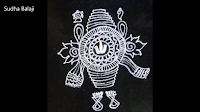
Shanku chakra namam rangoli kolam

Image
 An auspicious Pooja room kolam and hence not drawn at the entrance.  As in the case of many posts I have shown  the white kolam only.  It is preferable to decorate with kavi (ochre) colour.  Kavi is usually used for auspicious occasions. This kolam can be drawn for our Wednesday kolangal or Saturday kolam as these two days are important for Lord Vishnu We can also draw for Vaikunta Ekadasi festival, Purattasi month (the whole month is considered important for Lord Venkateswara) I have also added Goddess Lakshmi's Feet for this rangoli.  In traditional rangoli we represent Her through Feet patterns. The main rangoli represents the Lord through shanka and chakra designs with the Namam pattern at the centre. 🙏🙏 I receive few suggestions on social media - like lines should be drawn from top to bottom, patterns should be drawn clockwise and not counterclockwise Though I appreciate their views, I think that we must first encourage drawing kolam daily at the en...

Maavilai kolam mango leaf rangoli easy

Image
Mango leaves are considered auspicious in South India.   We invariably find toran made of mango leaves hung on the doorways of houses for festivals - Diwali, Sankranti, Varalakshmi Pooja Navratri and also during functions - housewarming, Aksharabhyasam, baby showers etc. So kolam with mango leaves called maavilai kolangal are also important to emphasise happy occasions in our homes.  Above what we see is a collection of rangolis using these patterns. When drawn in white we can decorate with geru to denote a function or festival. Rangoli auspicious Diwali  2 by 2 dots maavilai kolam 3 by 2 dots maavilai kolangal  4 by 4 dots mango leaves rangoli  5 by 3 dots mango leaf rangoli 7 by 4 dots maavilai rangoli 9 by 5 dots maavilai kolam - different type. maavialai thoranam kolam - 11 to 1 pulli design A very simple rangoli with 11 dots.  Still two steps have been shown to explain the design. The four patt...

Aishwarya kolam - for Friday, Puja

Image
I have a video for this kolam on my YouTube Channel.  This video has been the official video of YouTube for quite some time. Aishwarya patra rangoli  ( an important Devara mane rangoli )  or  aishwarya kolam   another popular rangoli with dots. I learnt some designs from my mother-in-law.  This is one of them.  It is considered to be auspicious and drawn on Fridays , during festivals like   Navarathri ,    Varalakshmi Vratha  and   Lakshmi Pooja.  This is an important Veli kizhamai kolam as it is called in Tamil.  Aishwarya kolam, Hase, Kubera kolam and Hridaya kamalam can be called as Mahalakshmi kolam as they are drawn on Fridays in the Puja room.  Friday is considered important for Mahalakshmi in our tradition. This kolam can also be drawn in the mandap where we place Goddess Lakshmi for Varalakshmi Vratham Pooja ( Varamahalakshmi Habba ) or for on the plank ( manai ) where we place Lord Ganesh du...

Hridaya kamalam - Lotus kolam for Friday

Image
Hridaya kamala kolam - a dots kolam for Friday for Puja room The rangoli after completion with just white rangoli powder. Usually, it is drawn this way with a kaavi (red) border. Usually drawn in white with kaavi border, I have used colours for the sequence and also have another picture with colours filled to give an idea for those who wish to learn this kolam  ( also called Lakshmi muggu ) how the petals are formed. This is the famous Hridaya kamalam. Lotus is used widely in rangolis and in auspicious rangolis too. This lotus design is a revered rangoli.   This rangoli and hase rangoli are considered to be very auspicious and hence considered to be Godess Laksmi's favourites.  This is meant only for  pooja  rooms and is not recommended for doorways, entrances.  The following images show the first three steps in drawing this lotus rangoli.  The first image shows the first step after the dot pattern.  The second image shows the continuity i...