Posts

Showing posts with the label festival recipes

Featured post

Easy rangoli designs - beginners

30+ rangoli kolam simple designs  Though I have drawn all the designs myself personally I am thankful to my family for the inputs, information and help in drafting all the posts so far.  I have used the terms kolam  rangoli quite freely in all the posts. Probably there would have been differences based on classical (!) explanations in the past but today kolams can also be colourful like rangolis both in the free hand and dots type  I find that even the terms rangoli kolam and kolam rangoli are used at  present. The only area where I think kolam are different are in sikku kolam and arisi maavu kolam. Both are beautiful, challenging and can be intricate. Rangoli is muggulu in Telugu and so this post will be useful for those in search of small and simple muggulu for beginners.  This post   may have answers  kutty rangoli /kolam designs The rangoli in the image below is one of the basic designs that can be used for learning.   Form a star w...
Easy Arisi kadalai paruppu payasam

Image
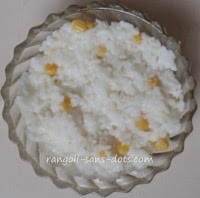
 One of the quickest and easiest payasam or kheer recipes that can be prepared in a jiffy.  For all festivals like V aramahalakshmi Pooja, Navarathri and Deepavali It is possible that occasionally sufficient time may not be available for kheer naivedyam that needs lot of time due to preparation of other dishes for a festival. On such occasions we can try this easy payasam. quick kheer recipe.  The simple procedure is given below. Fry rice and gram dhall in little ghee separately. For one cup rice take quarter cup gram dhal.  Mix them and cook in a pressure cooker. Add half cup jaggery and cardamom powder to little water in a vessel and heat it. When the jaggery melts add the rice and gram dhal mixture and continue cooking for two to three minutes. Once cooking is complete add grated coconut (optional). Remove the vessel from the stove, add fried cashew nuts.  One more neivedhiyam or offering is ready for Puja. This blog is primarily on rangoli - a reposit...

Pitla recipe Maharastrian style

Image
  Pitla recipe  This variety of pitla as it called can be prepared for festivals like Navratri, Varalakshmi Vratham or Ugadi. The ingredients required are t wo teaspoons of urad dal , one teaspoon of gram  dal , pepper , red chillies asafoetida and curry leaves. All the ingredients are roasted in little oil, curry leaves can be roasted separately also. Then grated coconut is added and the mixture is ground into a fine paste. Sauté with mustard seeds, urad dhall in a tava, add solution of tamarind soaked in water, allow it to boil. Then add the cooked vegetables - peanuts, beans and carrot slices and let the solution boil. Finally add already cooked thoor dhall and add salt to taste and boil for a few minutes We can use different vegetable combinations like yam and chick peas, bittergourd ( pavakkai ) and peanuts or ground nuts to make this delicious dish.   Pepper gives a fine flavour to pitla

Crispy ambode recipe without onion

Image
  Varamahalakshmi vratham  recipes - Ambode for naivedyam Ambode ( amaivadai in Tamil) in an important recipe for Ugadi festival. The following pics show the steps in making this traditional dish for this festival.    Soak gram dhall and red chillies in water for 45 minutes.   Drain the water, grind it coarsely as shown in the second photo. Add salt to taste while grinding.  Then add asafoetida, finely chopped coriander leaves and curry leaves. I have used grated coconut.  It is optional.  Make a medium sized ball, flatten it with your palm and fry to get the ambode shown in the third photo.   On auspicious days and festivals some do not add onion.   (If onion is added it becomes masal vadai ! and we don't add onion or garlic for festivals)  This is one of the important recipes along with poli for festivals . Preparation of the recipe through pictures                  ...

Puri kheer recipe in English

Image
Required ingredients 1. Chiroti rava or sooji (else use standard rava ) - 200 gram 2. Milk - 3/4 litre 3. Sugar -as desired 4. Cardamom 5. Cashew nuts 6. Raisins 7. Optional (almonds and saffron) Take required quantity of chiroti rava in a vessel and mix water to obtain a dough similar to poori dough.   Let the dough settle for at least two hours.  Knead the dough and using a rolling pin flatten as we do for poori or roti.   Cut the dough  with a suitable cutter in two directions to obtain square or rhombus shaped pieces and fry them in ghee (if you don't have objection to calories ) else use cooking oil.  Boil milk  and use flame in "sim" position. Add cardamom powder, saffron to it.  Now add the fried dough pieces to the milk and stir for a few minutes. Add required quantity of sugar.  Fry cashew nuts, raisins and add them to the kheer.  Your special kheer as shown in the photo below is ready to serve (and eat!). If standard rava is u...

Summer cool drinks panakam neer mor

Image
These two cool drinks are offered as naivedyam for Sri Rama Navamai.  Very thoughtful of our elders because this festival is celebrated in summer. They can also be very traditional home made cool drinks and hence may be healthy because we use dry ginger, jaggery and cut raw vegetables.   Panak or panagam recipe  Take fresh grated jaggery. Add water and dissolve the jaggery Filter the solution to remove dirt , if any. Add dry ginger powder ( sukku podi in Tamil ) and stir well Add cardamom powder Squeeze lemon juice - two one medium sized lemons Stir well and store in a fridge.  It is like Devamritham as we say on a hot summer day,  very refreshing drink Neer mor or spicy butter milk Add water to curd and stir well to make butter milk Add salt. Add peeled and cut mango pieces Add peeled and cut cucumber pieces Add asafoetida Add curry leaves saute ( mustard and cumin seeds ) These are quick and easy recipes described in qu...

Javvarisi payasam recipe in Tamil

Image
Sabudana kheer | Javvarisi payasam for Gokulashtami and Navratri The steps for making this kheer are given below.  If you like to view the video directly which is in Tamil it is available after the description and images. Traditionally what we do is for any javvarisi (sago) recipe is that we soak it in water for a few hours allow it to absorb water and then proceed with the recipe.  This is a different method wherein we do not soak it in water.   This is particularly useful when we have to make a quick payasam instantly.   The image below shows javvarisi and a mixture of almonds, cashews, pista powdered.  Actually, this powder I mix in milk and give it to suhasinis who come for thamboolam for Varalakshmi Vratham or Navratri. Take one measure of javvarisi and roast in a little ghee in a vessel called vanali in Tamil.  After some time the volume of the javvarisi spheres increases just as we get when we soak it in water.  Remove it and...