I had written earlier on jasmine an easy simple method of making jasmine garland using a needle and thread.
In fact, what we get is a densely set floral garland.
Stringing of roses is difficult because the petals are delicate and tend to fall when we try to string roses.
The roses should be fresh and used within a few hours.
Hence, it is better to string roses when they are fresh
Coming to jasmine, stringing them is difficult because the stalk is thin and small
(Initially it is better to learn stringing leaves or flowers with long stalk
Once they bloom it is slightly difficult as the petals interfere with stringing process.
Usually, the jasmine buds are strung, and the garland is stored in a piece of clean cloth made slightly wet with water
so that the flowers bloom the next day.
Too wet a cloth will result in the flowers getting damaged.
There is a variety of jasmine called mullai in Tamil for which the stringing process is also the same except the cloth
is made very wet for the flowers to bloom.
Nature has its own way for different flowers! Jasmine is white but is one of the most fragrant flowers and hence used for festivals
. I have four jasmine plants that bloom every day. I get a few flowers, and I offer them during regular prayer. In Tamil Nadu Madurai is famous for jasmine and Madurai malli as it is called is quite popular.
 |
| Jasmine flower garland |
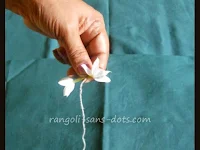
I have used a flower for kakada to demonstrate how to get this thick garland
First image shows to flowers placed one above the other with stalks over lapping, the string at the bottom
 |
| How to string flowers |
The next pic shows the flowers held with the thumb, with the string going around the stalks to hold them.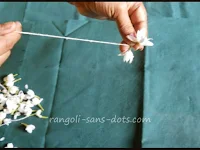 |
| How to string flower garland |
 |
| How to string flowers together |
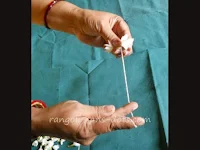
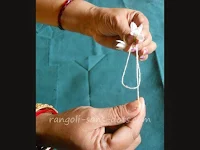
The third image shows the beginning of the formation of the knot using the fingers as shown, rolling them over the string, along the string then with the middle finger supporting the string roll the wrist around the string to get the position shown in the fourth image.
This is the most difficult part in this process as it involves rotating the fingers and wrist in different planes. |
| How to thread flowers |
The fifth image shows the formation of the ring which is inserted on the top of the flower as shown in the sixth image so that the the ring is over the overlapping stalks.
 |
| How to tie flowers with thread |
 |
| How to tie flower mala |
The final picture shows the string being pulled so that a knot forms around the overlapping portion of the stalks. Flower vendors doing this quite fast and mechanically. That is practice for us!
 |
| How to tie flower knot |
 |
| Flower garland idea |
If you are looking for information on
how to tie flowers , this post may be useful. Apart from kolam art, making different types of flower garlands using various methods, most of them are quite easy, one or two are difficult. While tying as we say colloquially, the flowers, they should be handled gently so that the petals are not damaged. I purchase loose flowers of various types malli, mullai and string them usually at night after dinner and offer them to God in our Pooja room and also to the temples that we visit for darshan. Whenever I plan to visit a temple, I always make it a point to string a garland with fragrant flowers (this kakada demo pictures, I added because the pictures were readily available) for both God and Goddesses. I inform the priest that the garlands are made by me and request him to adorn Him or Her immediately so that I can have darshan of God with the garland made by me. Usually, the temple priests oblige. It is really a blissful feeling. On rare occasions, if there is an Abhishekam or Pooja to be performed they are kind enough to tell that they will decorate Him or Her after the Pooja. Of course, if it is a popular temple, we have to move because lots of people will be waiting in the queue.


Comments