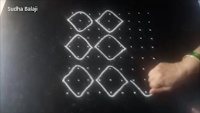
The first rangoli appears to be simple. Appearances can be deceptive. The step shown in the second image can be a bit tricky for some of us. Many sikku kolam are.
A few decades back, when I was young, it was not the era of plastic or stainless steel, yet.
So, we stored kola podi in coconut shells.
Firstly, it was an ecofriendly idea, since coconut shell is biodegradable. Also, it was ergonomic because we got the right grip on the shell while drawing the kolam i.e the size and shape was perfect.
We kept on recess on the wall near the entrance door, where oil lamps were placed. So, it was easy to pick it up in the morning and go to the courtyard to draw the rangoli of the day.
Also, kavi border was drawn with the coconut husk, nowadays we use a brush.
We kept our lives simple and did not have to worry about plastic waste etc. Having said that I have to accept that change is permanent.
9 by 9 chukki rangoli
 |
| 9 * 9 dots rangoli simple |
These designs are ubiquitous during Dhanrumasa in southern part of our country I started with Rangoli sans dots only (literally meaning rangoli designs without dots). Later I ventured into short chukki rangoli designs too based on viewers or readers' requests. I was reluctant to try this type of rangoli initially, but when I started trying, I was thrilled. It is like solving a puzzle or Mathematics problem. For all the three there may be many methods to solve, it is important to find the easiest path. That is what I try to offer through my videos and step by step images.
 |
9 dots rangoli kolam
|
Draw the white rangoli or add colourful borders around if you have space.
 |
| 9 to 9 chukki rangoli step by step |
11 to 1 chukki rangoli step by step
 |
| chukki rangoli 11 to 1 steps |
An image showing an intermediate step
 |
| 11 te 1 rangoli steps |
These types of rangoli designs are not only awesome, they also can challenge us
 |
| 11 chukkala rangoli |
If you are looking for 9 pulli sikku kolam , 11-1 sikku kolam you may find the step-by-step images useful. Dhanurmasa or Margazhi month between December 15 and January 15 every year is famous of bhajans and rangoli.
We find
beautiful rangoli designs adorning many homes in South India. I have shared two medium- sized kolam designs to be added to our repertoire. For this type or for that matter any traditional kolam fast and confident hand movement is essential to ensure that we do not get stuck anywhere and also to get neat lines. It may help if we practice on paper a few times before drawing on floor. Think of it as our biology diagrams or derivations in Physics, Mathematics that we practice several times before the actual exam. The only difference is exams can give us stress whereas kolam is stressbuster.
One of the common types of feedback on my video channels from people with knowledge of Mathematics is that "there appears to be rules and geometry in this art, what is it". My frank reply is that "I can only draw this art, mathematics involved is beyond my comprehension. I leave it to the experts in the field to decode."


Comments