Rangoli making tips and tricks
How do we get thin lines in rangoli. It is a simple trick. For drawing thin lines, we have have to take minimum kolam powder. This way we can draw thin lines. The more kola podi you take the thicker the lines will become. Also, lines should be drawn in a single stretch without joints. If there are joints, we try to hide them with kolam maavu and the lines will become thicker.
Thin lines in kolam are called ezhai. An ezhai is a single strand in a thread.
Two images as examples
If you observe the pictures, the curved lines are also drawn without joints. This technique of drawing straight and curved lines continuously
without any joints is the hallmark of a beautiful kolam. The more we practise the better we get at this technique.
Kolam art as it is called in Tamil Nadu, has a unique selling proposition, symmetry and thin lines and such lines reveal the dexterity one possesses. Thick lines are not the hallmark of this art form.
 |
| White rangoli designs for daily purpose, Friday |
The first illustration shows one of my lines rangoli creations. The four curved lines converge as shown and transform into birds, maybe white peacocks if we take into consideration the crest. Since it is meant to be a small and compact kolam, the tail has been represented by spirals, very short lines and dots. Also, the space available is just sufficient for such a representation. Drawing long patterns to match the tail and feathers of a peacock may result in an awkward display as the tails will extend outside the main design. That is the beauty of this art, we can convey our message with little effort and small motifs. No wonder millions of us draw it daily at the entrance of our homes. All of us have a lot of imagination and creativity, we have to master the art by following the tips etc. how to draw lines, how to avoid joints in ezhai etc. to get the best possible result.
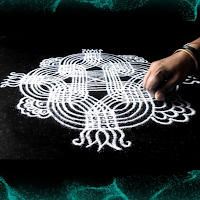 |
| White rangoli designs big and beautiful |
The second illustration shows a classical padi kolam or the art of forming beautiful patterns with just lines. Traditionally two, four or 6 lines are used. I use five lines also. For an excellent result, thinner the lines the more compact the rangoli is and the more attractive it is. Lal or red colour, kaavi as we call it to make it appear more auspicious. Red colour is used to decorate the periphery and also added whereever feasible inside the rangoli muggulu designs without obscuring the white kolam.


Comments