We use the term "ezhai" in Tamil Nadu when referring to line rangoli designs. Actually, ezhai does not mean line only.
Ezhai refers to a strand of a thread. It can be considered as a metaphor. We should draw lines that are as thin as a strand of a thread.
Of course, with
kola podi the thinnest possible lines that can be drawn should be drawn when we make this type of rangoli.
This is also a beautiful method of representing this simple art, just like double stroke technique.
Remember to decorate the kolam with wet kaavi (we can draw using a cloth, I use a cotton bud dipped in wet kaavi )
to indicate that it is an auspicious function or festival.
The pics above show the step-by-step procedure to draw the design. Maintaining thin lines throughout comes with practice.
Rangoli tip How to draw thin lines - Take minimum quantity of kolam podi.
Step by step pictures for line rangoli padi kolam
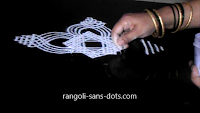 |
Old time rangoli using lines
|
The next step in the rangoli for Shravana Purnima Upkarmam
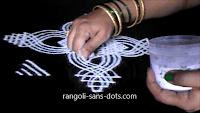 |
| old style muggulu, line kolam |
Line kolam without dots for festivals - another pic
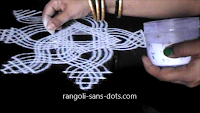 |
| padi kolam for Friday also |
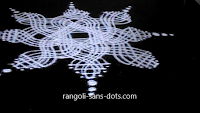 |
| padi kolam simple and beautiful |
There are some among my followers who consider me as the first rangoli teacher. It may be possible because I was among the first to start "teaching" kolam on social media through blogger and YouTube. When viewers address me as Amma or Tai (in Marathi means elder sister) it moves me, and I get emotional. I have to add hastily that the knowledge I have is infinitesimal. So, we can all learn from others too who are sharing their knowledge through rangoli videos. So far as this post is concerned if it appears to be difficult if we observe the images four or five times, we should be able to understand.
Rangoli tip: A viewer asked what kolam should be drawn when leaving the house for a wedding in the family and again returning to the house after the celebrations. I am of the opinion while padi kolam is preferable, we can draw any
free hand rangoli or dot kolam except sikku kolam. Kaavi decoration of the design is preferable for auspicious occasions.


Comments