This is a huge elephant kolam (excuse the pun !!) with 21 by 1 dots.
One of the favourites for Sankranthi muggulu or Pongal kolam. It is not very time consuming since the patterns repeat.
Once we know how to draw one of the elephants (of the herd !!) it is easy to draw the other elephants.
The patterns at the centre and those at the dots remaining at the four corners can be drawn according to our wish.
This is also suitable for New Year rangoli design if you are looking for big kolam
I presume that someone who comes in search of grand kolam may have a long experience in drawing rangoli the traditional way. So, the steps are in the reverse order :)
I have shown only the white muggu. We can add colour as we please. That is the liberty we have in kolam art.
Elephants need not be grey; they can be filled with any bright colour.
If you are looking for chukki rangoli big size, big pulli kolam designs with steps or big dot rangoli designs you may like it.
This is a common big kolam and so many may be aware of it.
It is for those who want to learn and for others who want to revive nostalgic memories of their childhood when they drew this for Pongal or Bhogi.
 |
| Old traditional rangoli with majestic elephants in white colour |
Big muggulu for festivals step by step - Five plus pictures showing the steps for this white elephant (not the idiom!) rangoli. For pedda muggulu with dots, more than usual number of images are required so that all including beginners can learn. Though children may like to draw elephants whether it is a suitable rangoli for kids may be decided for the parents themselves. It is quite a task for us, adults. Probably, it can be done as an art exercise for the entire family for festivals like Bhogi and Deepavali too.
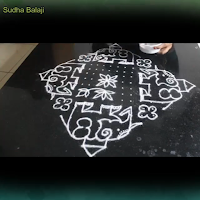 |
Ancient rangoli designs another step
|
The seven-by-seven dot grid at the centre is used for a creative rangoli pattern with flower designs. Actually, this pattern alone can be used as can be used a simple muggu at the entrance. We can use our imagination to create any other design also at the centre.
 |
| Vintage rangoli designs steps through photo collection |
One more step for this Sankranthi big muggulu. The four images - one above and three below show the how the white enugu is drawn step by step. The fifth image at the bottom shows a completed elephant in white muggulu step, so that we can compare and it should be easy to proceed with that illustration as reference.
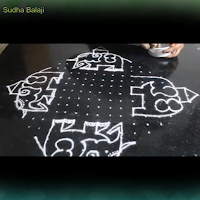 |
| Old rangoli kolam picture shows one more step |
One of the biggest muggulu designs with dots step by step through images, it is also one of the most beautiful old rangoli designs with dots, my mother drew it, in Vizianagaram, Omalur and Chennai, we learnt from her, I am told that my grandmother also drew it and she lived in Vizianagaram, My elder sister (who lives in Nagpur) drew it during Navaratri in Omalur where we performed Sai Baba Aradhana. She started early in the morning, she is a perfectionist in anything she does, so she allocated two to three hours for drawing this old chukki rangoli.
 |
| Old rangoli ideas for festivals |
Big muggulu with dots can also be drawn for Diwali , if we want to try traditional rangoli designs
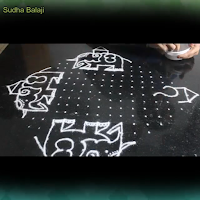 |
| old age rangoli steps through pics |
The first step in this enugu muggu. It can be also used for drawing two elephants facing each other. The dot pattern required may be seen in the photos, I think 7 dots 4 rows should be enough for one white elephant design. This may be an interesting activity for kids of suitable age.
 |
| old big rangoli step by step pics |
While I am comfortable drawing on any surface be it cement floor, tiles or mud floor (it was mud floor in our hometown where I learnt my kolam from my mother and elder sisters).
I prefer to draw only on the black granite slab that I purchased exclusively for my rangoli videos and images because the white pattern is clear in the black background.
This information I had to share because there were a few, in fact one or two comments on why I choose this background only.
After drawing the elephants what patterns can emerge from the remaining dots. It is left to our imagination.
There is something called poetic licence. Just like poets have the freedom to depart from conventional rules for the purpose of meter etc. we can also take the liberty of drawing designs according to our imagination
However, generally it is advisable to choose something that is in agreement with the main rangoli. For example, if space is available, we can try sugarcane at the centre.


Comments